
Notices from £100
Notice within working 24 Hours
20+ Years of Legal Expertise
Guaranteed Eviction Packages.

Fixed‑Fee Tenant Eviction in England & Wales

We are National, reliable eviction solicitors that will legally assist you in the lawful eviction of your tenants.

For more information about our services, or to find out exactly where you stand and the range of options available complete our form or call us today on 0333 880 3494

  Legally secure evictions carried out quickly and efficiently.
  Protect your rental income with fast, accurate action.
  Helping landlords avoid costly legal errors.
  Prevent delays and safeguard against unlawful eviction claims.
Contact us today to prevent further losses & issues arising.

Free Solicitor Call Back

Answer a few quick questions we’ll call you back today.

By submitting, you agree to be contacted about your enquiry. No obligation. Privacy policy.

Prefer to call? Speak to a solicitor now → 0333 880 3494

Free Solicitor Call Back

Answer a few quick questions we’ll call you back today.

By submitting, you agree to be contacted about your enquiry. No obligation. Privacy policy.

Prefer to call? Speak to a solicitor now → 0333 880 3494

Your Eviction Case.

Led by Expertise You Can Trust

Ashley Leung — Director & Principal Solicitor

  • SRA Regulated | 15+ Years’ Experience
  • Former Slater & Gordon Solicitor (Top-100 UK Law Firm)
  • Training Principal for Trainee Solicitors
  • Former Litigation Manager
  • Wealth of experience across multiple disciplines of law

Fixed Fee Eviction

03338803494

“I make sure your eviction is handled lawfully, efficiently, and with complete transparency.”

Evict Today

Start My Eviction

What is Tenant Eviction?

Eviction is the legal process a landlord must follow to regain possession of a rented property. You cannot simply change the locks or remove tenants yourself doing so risks an illegal eviction claim.

  •   Section 21 notice (no-fault) — used when you want the property back at the end of a fixed term or during a periodic tenancy. Minimum 2 months’ notice, and you must have met paperwork duties (deposit protection, Gas Safety, EPC, How to Rent guide).
  •   Section 8 notice (breach) — used where the tenant has broken the tenancy, for example rent arrears, anti-social behaviour, or damage. Notice is typically 2 weeks to 2 months depending on the legal grounds.
  •   Notice to Quit (Non-Tenancy Situations) - Not every occupier is a tenant. In some cases, individuals remain in a property without holding a formal tenancy agreement. These may include:
  •   Lodgers or licensees.
  •   Squatters or unauthorised occupiers.
  •   Family members staying without agreement.
  •   Former partners who remain in the property. In these situations, a Notice to Quit must still be served. However, the rights of these occupiers are generally weaker than those of tenants. This makes the process faster but landlords must still proceed carefully to avoid any claims of unlawful eviction.

Section 8 Grounds for Possession

A Section 8 notice is used when a tenant has breached the tenancy agreement. The law sets out specific grounds that a landlord can rely on, split into two categories: mandatory and discretionary.

Mandatory Grounds (Court must grant possession)

If one of these grounds is proven, the court is required to grant possession:

  • Ground 1 – Landlord intends to move back into the property as their main home.
  • Ground 2 – Mortgage lender seeks possession for sale of the property.
  • Ground 3 – Holiday let of less than 8 months.
  • Ground 4 – Student accommodation required for a new academic year.
  • Ground 5 – Property required for a minister of religion.
  • Ground 6 – Redevelopment or demolition of the property.
  • Ground 7 – The tenant has died and no successor tenancy applies.
  • Ground 8 – Serious rent arrears (usually 2 months or more).

Discretionary Grounds (Court may grant possession)

Here, the judge has the power to decide whether possession is reasonable:

  • Ground 9 – Suitable alternative accommodation is available.
  • Ground 10 – Some rent arrears outstanding.
  • Ground 11 – Persistent late payment of rent.
  • Ground 12 – Any breach of the tenancy agreement other than rent.
  • Ground 13 – Neglect or damage causing deterioration of the property.
  • Ground 14 – Nuisance, anti-social behaviour, or unlawful activity.
  • Ground 15 – Damage to the landlord’s furniture.
  • Ground 16 – Occupation linked to former employment has ended.
  • Ground 17 – Tenancy was granted based on false information.

How We Help

We assess your tenancy, select the strongest grounds for possession, and serve a compliant Section 8 notice within 24 hours. Our eviction experts ensure the notice is accurate and enforceable, giving you the best chance of success in court.

Section 21 ‘No-Fault’ Possession

A Section 21 notice allows landlords to take back their property at the end of a fixed-term tenancy or during a periodic tenancy without needing to prove any wrongdoing by the tenant. It’s often referred to as the “no-fault” eviction route.

To be valid, landlords must follow strict legal rules. The tenancy deposit must be protected in a government-approved scheme, tenants must have received the required prescribed information, and documents such as the “How to Rent” guide, an EPC, and a valid gas and electrical safety certificate must have been provided. Failure to meet these conditions can make the notice invalid.

The minimum notice period is two months, but the notice cannot be served within the first four months of the tenancy. In certain cases, landlords can use the accelerated possession procedure, a paper-based route where the court may grant possession without the need for a hearing if all documents are correct.

It’s important to note that rent arrears cannot be claimed under Section 21. If rent is owed, a separate claim must be issued under Section 8 or through the court.

Why Section 21 Matters

  • Provides a clear legal route for landlords to recover their property.
  • Can be faster and more straightforward than Section 8 if all conditions are met.
  • Avoids the need to prove tenant misconduct.

How We Help Landlords

Our eviction team checks every compliance requirement before issuing a notice. We draft and serve a fully valid Section 21 notice within 24 hours and support you through the court process if your tenant does not vacate.

With us, you can be confident your Section 21 notice is valid, enforceable, and processed efficiently — protecting your rights and avoiding costly delays.

Please be aware that the upcoming Renters’ Reform Bill will abolish Section 21 notices. Landlords should act now to protect their position

Notice to Quit / Non-Tenancy Possession

A Notice to Quit is used in situations where the occupier is not a tenant under an assured shorthold tenancy. It applies to lodgers, licensees, squatters, trespassers, or former tenants who remain in the property after their tenancy has ended.

Although these occupiers have fewer rights than tenants, landlords must still serve the correct legal notice before they can lawfully recover possession. The form and wording of the notice are crucial. A defective notice can cause serious delays, forcing the landlord to restart the process.

Notice Periods

Notice periods for a Notice to Quit are generally shorter than for Section 21 or Section 8. In many cases, it may be as little as 28 days, or even less where trespassers are involved. However, the exact period depends on the occupier’s legal status and any agreement in place.

Why Precision Counts

Serving the wrong notice, or wording it incorrectly, can result in wasted time and expense. The court expects absolute accuracy in how notices are prepared and delivered.

How We Support Landlords

  • We assess whether the occupier is a tenant, lodger, licensee, or trespasser.
  • We confirm the correct notice period for the circumstances.
  • We draft and serve a compliant Notice to Quit within 24 hours.
  • If the occupier refuses to leave, we guide you through the possession order and enforcement process.

Protecting Your Property Rights

A Notice to Quit is often the quickest way to recover property from non-tenants, but only if it’s served correctly. Our expertise ensures the notice is valid and that you can move forward with confidence, knowing the process is legally sound and your property will be recovered as quickly as possible.

Contact our specialist eviction solicitors today for a fixed fee guaranteed eviction.

Eviction Notices: Tenants vs Non-Tenants
Type of Occupier Notice Required Rights & Protections Typical Process Risks if Done Incorrectly
Assured Shorthold Tenants (ASTs) Section 21 (no fault) or Section 8 (fault-based) Strong legal rights, must follow strict Housing Act rules Court order required for possession Claims of unlawful eviction, delays, compensation
Non-Tenants (lodgers, licensees, squatters, family, ex-partners) Notice to Quit Weaker rights than tenants, but still some protection Notice must be served, then court order if they refuse to leave Allegations of unlawful eviction, counterclaims for damages or belongings
Rent Arrears Tenants Section 8 (Grounds 8, 10, 11) Strongest court protection — arrears must be proved Court hearing and possession order Case dismissed if procedure flawed; landlord pays costs
Former Tenants (after fixed term expired, no renewal) Section 21 (accelerated) Limited but still recognised tenancy rights Accelerated possession claim (no hearing in some cases) Delay, costs, invalid notice if paperwork incorrect

Possession Orders – Taking Your Tenant to Court

When a Notice Isn’t Enough

Sometimes a tenant won’t move out even after you’ve given them the proper notice. When that happens, the next step is to ask the County Court for a possession order. Acting quickly is important — every delay can mean lost rent and extra stress for you as a landlord.

Leave the Legal Side to Us

You don’t need to know the court process inside out or worry about making a mistake with the paperwork. Our tenant eviction specialists deal with possession claims every day. We prepare the forms, lodge them with the court, and guide you through each stage so you can focus on moving forward.

Why Work With Our Eviction Team?

  • We have long-standing experience handling possession proceedings for landlords.
  • You’ll get practical advice in plain English, not complicated legal jargon.
  • We make sure your claim is done properly, on time, and with the best chance of success.

Support From Start to Finish

Going to court can feel overwhelming, but you won’t be left to figure it out alone. We keep you informed at every stage and ensure everything is handled correctly. With our help, you can move through the eviction process smoothly and regain possession of your property with confidence.

Take the stress out of applying for a possession order — let our eviction experts deal with the court so you can focus on getting your property back.
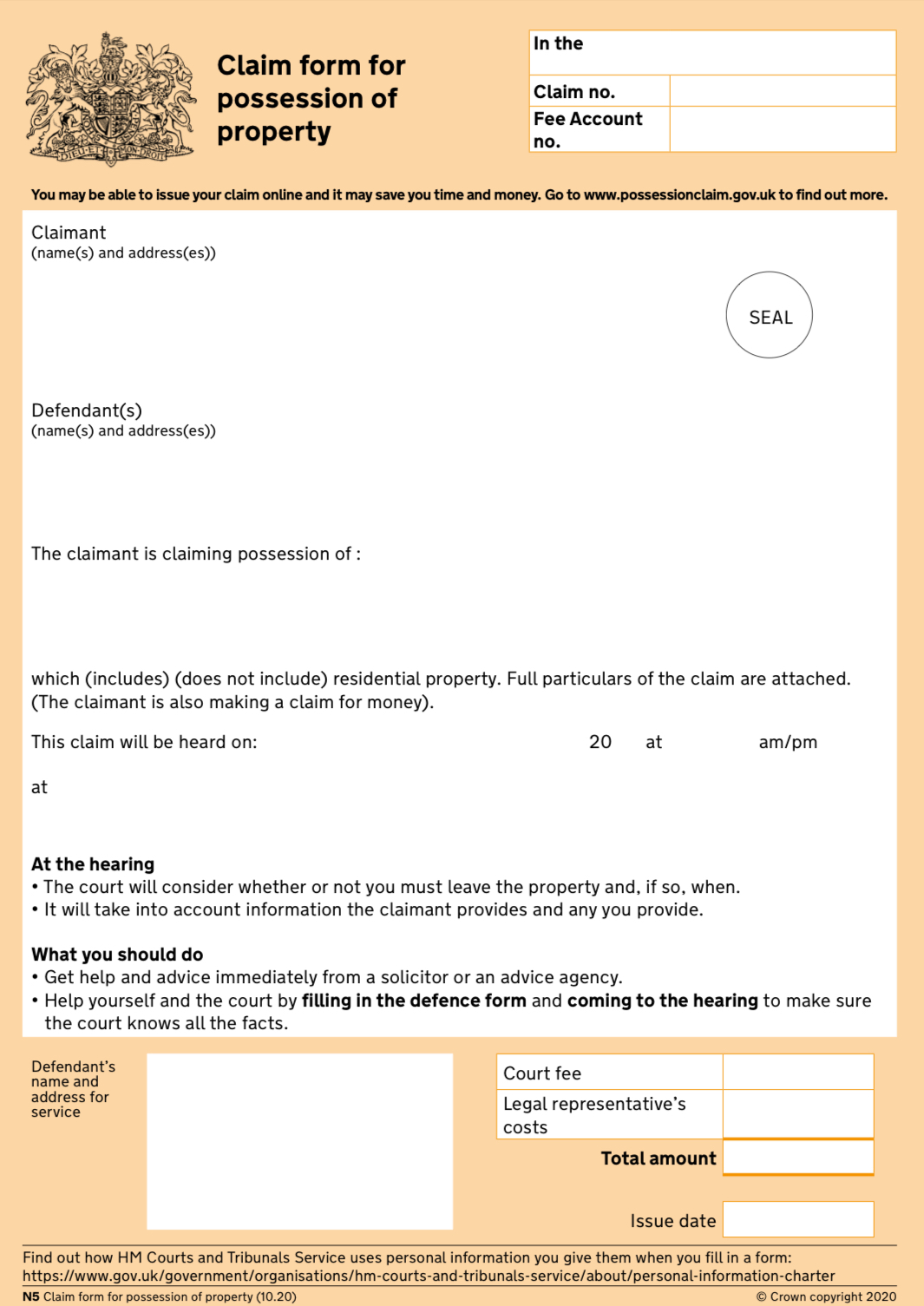
Eviction Claim Form (N5)

The form that officially starts the eviction process in court.Even small mistakes can lead to rejection.Our team prepares and files this correctly the first time.

Start your eviction claim with us today

Eviction Process Guide 2025

1
Serve the right notice

Solicitor-drafted Section 8 or Section 21 within 24 hours.

2
Defended claims

Full response & representation if your tenant disputes.

3
Issue court proceedings

Standard or Accelerated Possession Orders.

4
Attend hearings

Nationwide representation with evidence bundles prepared.

5
Enforce with bailiffs

Warrant applications & Bailiff coordination.

6
Change the locks

Secure vacant possession once a court order enforced.

Fixed-Fee Eviction Packages

Clear, upfront pricing — no hidden extras. All fees are subject to VAT at 20%.

Court fees (disbursements) payable to the court: £404 for a possession order (standard or accelerated) and £148 for a warrant of possession (bailiff enforcement).

Package 1 – Notice Service

£100 + VAT

  •   Solicitor-prepared Section 8 or Section 21 notice
  •   Tenancy document review for compliance
  •   Guidance to resolve issues before service
  •   Peace of mind your notice is valid
Book Now

Package 2- Used By Most Law Firms

£1,200 + VAT

  •   Includes everything in Package 1
  •   Full tenancy review, advice and guidance.
  •   Complete process from start to finish.
  •   Legal representation at court.
  •   Bailiff enforcement arranged if required.
Book Now

Important: Fixed fees cover our professional work set out above. They do not include disbursements (e.g., court fees) or third-party costs unless specified. We will confirm scope, disbursements, and next steps in our engagement letter before starting work.

Ready to Start?

Speak to an eviction solicitor now. Notices from £100. Same-day callback.

How Our Eviction Solicitors Help

  •   Serve the correct notice — Section 8 or Section 21 drafted by solicitors within 24 hours.
  •   Court application & representation — standard or accelerated possession claims, hearings covered.
  •   Bailiff enforcement — N325 warrant applications and coordination with County Court Bailiffs.
  •   Fixed fees — notices from £100, clear stages and transparent pricing.

Let’s us get your property back today.

Why Landlords Choose Us

  •   SRA-regulated solicitors of England & Wales.
  •   Notices from £100 with clear, fixed fees at each stage.
  •   24-hour turnaround on new eviction notices.
  •   Proven Track Record 20+ experienced lawyers and over 1,000 landlord cases successfully resolved.
  •   We’re landlords ourselves practical, commercial advice.
  •   Fixed, Guaranteed Eviction Packages cost certainty and guaranteed delivery from start to finish.

Get your property back and leave the hassle to us

Why Legal Eviction Matters

It may feel tempting to use shortcuts like changing locks or intimidating tenants, but illegal eviction is a criminal offence. Risks include:

  •   Tenant compensation claims
  •   Criminal charges
  •   Losing your possession claim
  •   Being forced to pay your tenant’s legal costs
  • Unlawful methods include:
  •   Locking the tenant out.
  •   Removing belongings.
  •   Cutting off utilities.
  •   Harassing the tenant.

Common Reasons Landlords Evict Tenants

  •   Rent Arrears – Non-payment of rent is the most common cause. Unpaid rent affects your cash flow and mortgage obligations. Courts treat arrears seriously, especially under Ground 8 (mandatory).
  •   Illegal Activity – Properties used for drugs, prostitution, or criminal behaviour expose landlords to risk. Immediate legal action may be possible under Section 8.
  •   Property Damage – When repairs exceed deposits, eviction may be necessary to stop further damage.
  •    Anti-Social Behaviour – Neighbours or other tenants may complain of nuisance, noise, or threats. This can justify eviction on discretionary grounds.
  •   Breach of Tenancy Agreement – Examples include subletting without permission, keeping pets where banned, or exceeding occupancy limits.
  •   Landlord’s Own Need – Wanting to move back in or sell the property is valid under certain grounds and Section 21.
  •   Trust us to get your property back

N325 Form – Request for Warrant of Possession

What the N325 Form Does

Once you’ve secured a possession order from the County Court, if your tenant still refuses to leave, the next step is to apply for a warrant of possession. This is done using the N325 form. The warrant authorises County Court bailiffs to attend the property and lawfully remove the tenant.

Why It Matters

A possession order on its own does not automatically remove a tenant. If they ignore the court order, you must take the additional step of requesting enforcement. Completing the N325 form correctly is crucial because it instructs the court to arrange bailiff action. Without it, you could be left waiting indefinitely while the tenant remains in the property.

How We Can Help Landlords

Our eviction team makes sure your N325 application is handled properly and without delay. We:

  • Complete the N325 form on your behalf.
  • File it with the appropriate County Court.
  • Guide you through what to expect from the bailiff appointment and timescales.

The Final Step in Regaining Your Property

With the N325 warrant process, you can be confident the eviction will be carried out lawfully and effectively. Our team supports you right up to the moment you get the keys back in your hand, ensuring no detail is missed along the way.
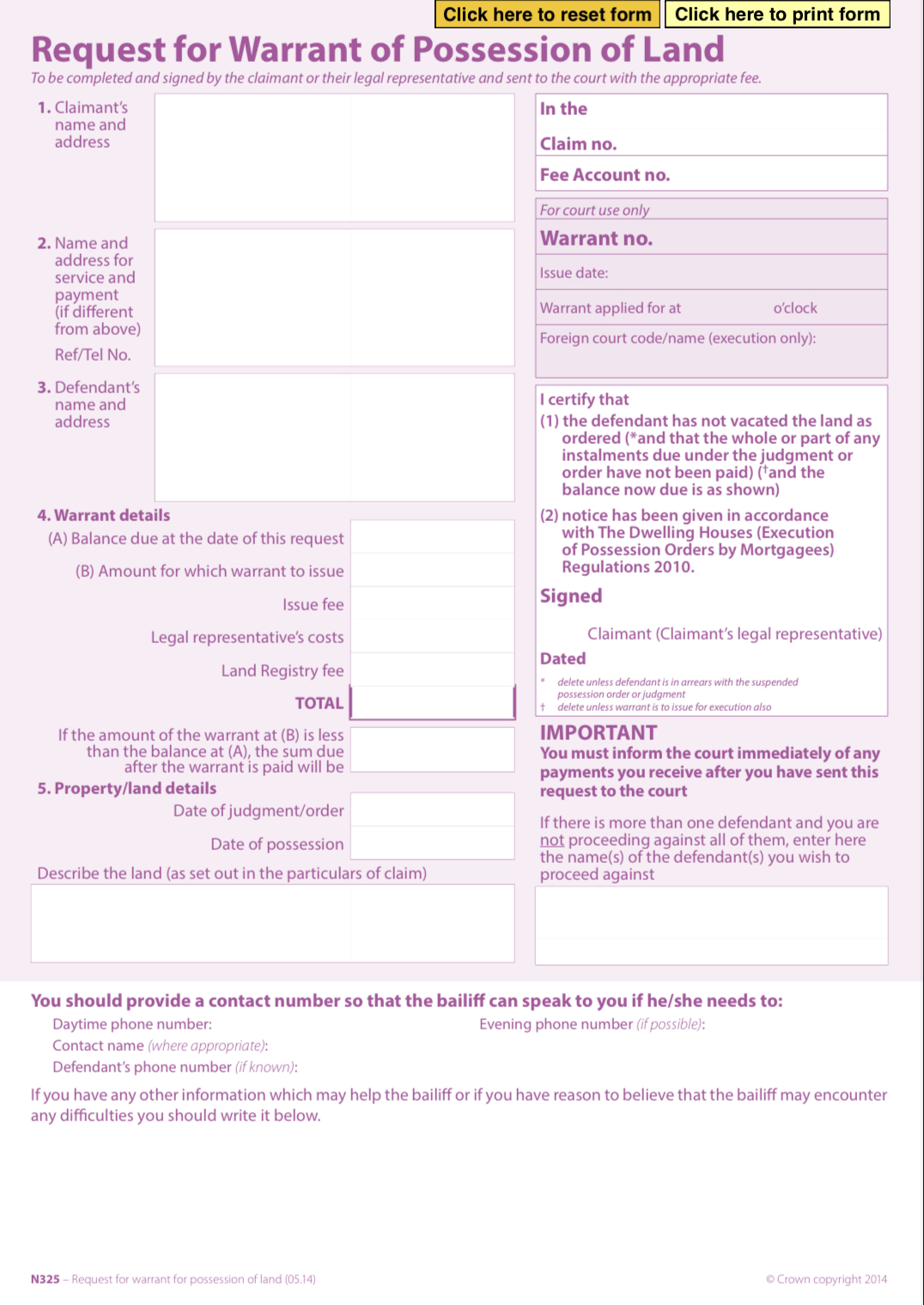
N325 – Request for Warrant of Possession

Filed after a possession order to send in the bailiffs.We manage the process so you get your property back quickly.

Book bailiff enforcement today

Trusted by Landlords Nationwide

★★★★☆

Handled my Section 21 case quickly and professionally. Fixed fees, no surprises.

J. Patel, London
★★★★★

Clear advice and possession granted within weeks. Highly recommended.

M. Green, Manchester
★★★★★

Same-day callback and end-to-end support through court and bailiffs.

R. Evans, Cardiff
★★★★★

Clear advice and possession granted within weeks. Highly recommended.

M. Green, Manchester

Real Scenarios We Handle

  •   Rent arrears (Birmingham): Section 8 on Grounds 8, 10 and 11; outright possession secured after hearing.
  •   Anti-social behaviour (London): Ground 14 notice and urgent application; suspended order with strict terms.
  •   No-fault possession (Manchester): Section 21 with accelerated claim; possession granted on the papers.

Outcomes depend on evidence and local court availability.

Some cities and towns we worked in:

  • London
  • Cardiff
  • Manchester
  • Birmingham
  • Wales
  • York

Don’t risk lost rent or costly delays.

Get solicitor‑led eviction support today:

Notices from just £100. Fixed-fee, nationwide solicitor service

Common Tenant Defences to Eviction

When landlords issue eviction notices, tenants may raise legal defences to delay or challenge the process. Some of the most common include:

  •   Incorrect Paperwork: If the landlord has not protected the deposit, failed to serve a Gas Safety Certificate, EPC, or the “How to Rent” guide, a Section 21 notice can be invalid.
  •    Disrepair Counterclaims: Tenants may argue the landlord failed to maintain the property, using housing disrepair as a defence against eviction.
  •    Discrimination or Retaliation: Claims that eviction was served because the tenant complained about repairs or exercised legal rights.
  •    Incorrect Notice Period: If the notice does not give the correct statutory timeframe, it may be struck out.
  •    Payment Disputes: Tenants may show evidence that arrears are lower than claimed, or that Housing Benefit/Universal Credit payments are pending.
  •   Procedural Errors in Court: Mistakes in the possession claim form or evidence bundle can lead to delays or dismissal.

Frequently Asked Questions

Typically 4–8 weeks, depending on the route, court backlogs, and whether the tenant defends.
No. Unless there was never a tenancy (rare and risky), changing locks is illegal. Only bailiffs acting under a court warrant can remove tenants.
We prepare your evidence, attend hearings, and respond to defences (e.g., disrepair claims). Having a solicitor increases your chance of success.
Yes. Eviction legal fees are usually deductible as a rental business expense.
Yes. If the occupier refuses to leave after the notice period expires, a court order is normally required to lawfully regain possession of the property. Attempting to remove them without a court order risks an unlawful eviction claim.
Section 21 applies to tenants under an Assured Shorthold Tenancy (AST) and requires strict compliance with Housing Act rules. A Notice to Quit is used for non-tenants, who generally have weaker rights. However, both require correct service and may involve court proceedings if the occupier refuses to leave.
Typically, a Notice to Quit gives the occupier at least 28 days to leave, but the exact period can depend on the agreement and circumstances. Serving the correct notice length is crucial to avoid delays or challenges in court.
You can find official guidance on eviction at:
1. https://www.gov.uk/private-renting-evictions
2. https://www.citizensadvice.org.uk/housing/eviction/getting-evicted/
While these sources provide useful information, they only give general advice. They won’t prepare the legal paperwork, represent you in court, or handle complex tenant disputes.
FAQ visual

Free Eviction Review

Complete the form and a solicitor will call you back. We’ll confirm eligibility, the correct notice, and fixed‑fee stages.

We’ll never change locks without a court warrant. Notices from £100.
Phone Contact Form